


Skeeper Care — Digital Health & IoT
Lifting D30 retention by 19pt by turning measurements into a daily habit
Service
Skeeper Care (Heart & Lung Monitoring App)
Feature
Home & health routine
Role
UX lead: strategy, flows, and Home design (1 of 2 designers)
Worked with
Product Designer, Developers (Android, iOS)
Summary
Skeeper Care is an IoT health platform.
We solved the low engagement issue by turning irregular measurements into a guided health routine.
Current usage pattern
Usage was reactive rather than preventive.
Lack of guidance led to inconsistent logging and high churn rates.
Designing the measurement loop
Designed a step-by-step cycle to guide users.
Used contextual reminders to encourage consistent measurement.
Key metrics
+37% MAU
Increased user activation via habit-forming features.
+19pt D30 Retention
More users were still measuring a month after signup.
User Perspective
"The device is enough for me."
Instant hardware feedback made digital logging feel like a redundant chore.
Lack of long-term motivation to open the app.
Business Perspective
Data stopped at the device
Isolated data logs lost clinical value, failing to provide long-term care.
High churn rate after the initial product purchase.

Most measurements never reached the app
68.75% of device measurements were taken without opening the app.
Discovery
The observed reality


Research evidence
Perception gap
Survey (n=48)
Behavioral friction
Field Interviews (n=5)
The goal shifted
The app's competitor wasn't another digital product, but the user’s existing analog habit. We needed to transform "Logging" into a "Guided Health Routine."

Redesigned the home screen to prompt users with "Ready for today's check-up?", so the app starts the routine instead of waiting to be opened.

Digitizing the continuity of paper logs. Replaced fragmented charts with a periodic cycle view (7/30 days), mirroring the simplicity and flow of users' familiar analog routines.
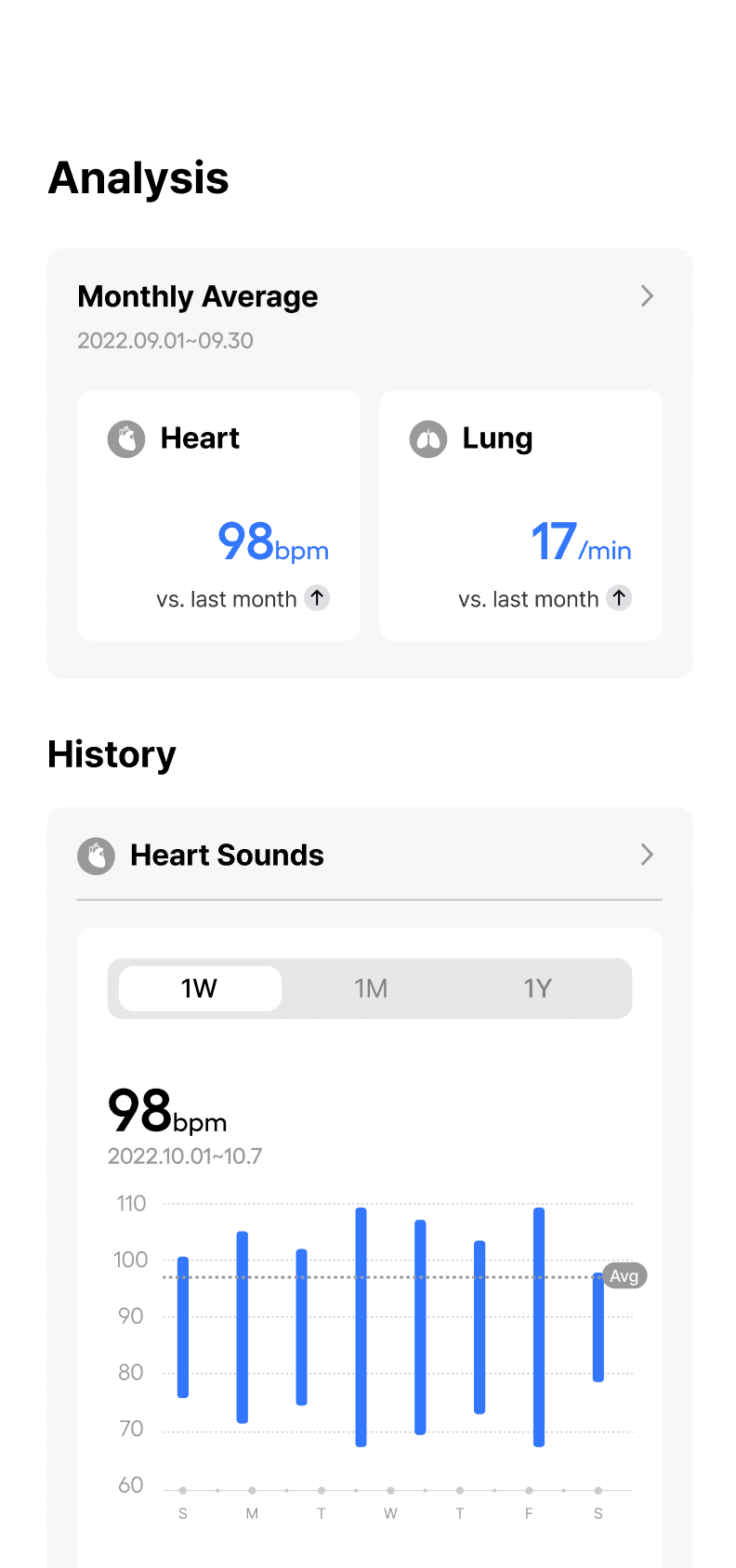
Giving meaning to isolated numbers. Provided contextual analysis for each result and implemented a smart notification system so users always knew when to measure next.

Validation
Behavioral validation
In usability tests with 5 participants, the new check-up routine removed the confusion we saw in the old flow: all 5 correctly identified when their next measurement was due.
Business Impact
+37% MAU
Increased recurring app usage.
*Compared to the 3 months before launch; device sales stayed flat over this period.
+19pt D30 Retention
More users were still measuring a month after signup.
*Data within 90 days of release
"I used to forget my check-ups, but the smart reminders helped me stay consistent. I was able to catch subtle changes and visit the doctor at the right time."
— Beta user, 60s, monitoring hypertension
Reflection
Hardware provides utility; software builds the relationship
Narrative over features
Hardware provides the utility, but software builds the relationship.
I learned that even the most advanced device needs to give users a reason to return beyond a single measurement.
Designing for habits
Shifting behavior requires more than a new feature; it requires respecting existing analog routines.
We succeeded by digitizing the intuitive flow and low friction of the paper logs that users already trusted.
What's next?